Showing posts with label Otakuology. Show all posts

Sunday, December 29, 2013

Bomb the Con

Comiket bomb threat
Comiket crisis averted. On December 15th police apprehended the man suspected of menacing Kuroko’s Basketball events with potentially lethal hydrogen sulfide gas from October of last year. The timing couldn’t be better for dojinshi circles. Kuroko and his teammates will ship in time for winter Comiket 85 after a year-long forced sabbatical. But despite being the most publicized terrorist threat in Comiket history, the potential body count pales in comparison to the Tokyo Big Sight Bomb Threat of summer ‘98.

As if to mark the third anniversary of the Aum Shinrikyo doomsday cult’s sarin gas attack on the Tokyo subway, a group of radicals identifying themselves as the Japan Purification Federation released a chilling ultimatum--they would blow up Comiket 54 and anime fandom with it on August 15th, 1998. Their warning:

///

“Stop! And consider the amount of disgust and repulsion that the otaku race create within society. Otaku--those who can only articulate themselves in terms of anime, those who crowd cafes after anime films for heated discussions, those who are introverts that can only love anime characters, those who flush billions of our nation’s precious currency into the toilet known as the ‘anime industry’--they must be exterminated with extreme prejudice.”

///

Most Comiket attendees plan a route to navigate the 35,000-plus dojin circles exhibiting during the three-day event. The Japan Purification Federation was no exception--except their itinerary was optimized for maximum death and destruction. They would begin the cleansing at midday when the otaku population was at its peak and the winding lines around popular tables made moving--and escape--an impossibility.

///

Phase I: Begin Cleansing

Initiate attack in the West Hall with daisy-chained M18A1 claymore mines along wall from Point A to Point D. Anyone within the 50m kill zone will be ripped to shreds by shrapnel before they can react. Deafening explosions will create mass panic among survivors who will naturally flee towards the exits and into another set of linked mines (Point E to Point G, then Point H-K, then Point L to Point N). The anti-tank mine at Point O will put any survivors out of their misery. 

Phase II: East Hall Search and Destroy Operation

Simultaneously detonate claymores at Point P in East Hall 1 and East Hall 4. The stampeding crowd will form a gridlock to be pushed forward by sequential explosions from Point Q through Point W. Once the otaku are corralled into the central hallway, ordinance along Point X will detonate, eliminating 90% of the target. Those outside of the kill zone will be left to stumble through bodies, blood and steel ball shrapnel to reflect on their wasted lives until the anti-tank mines at Point Y bring down the roof and release them from existence.

Phase III: Grand Finale

Targets who make it through the carnage of the East Hall may try to escape via the parking lot. They will be greeted with a mine field. Here they will be forced to take responsibility for their fate for the first and last time. Explosions will ignite surrounding vehicles, creating a sea of flame.

Based on previous attendance figures we can expect 250,000 otaku to gather over the day. If even one quarter are present at the time of the attack, that means 50,000 vermin will be exterminated. Shrinking the market will in turn cripple publishers reliant on otaku business and suspend future Comiket and dojinshi events, creating a downward economic spiral.

We will destroy Comiket by expunging the creators.

///


A terrifying voice of absolute madness.

Had their plot succeeded, it would have been the largest act of domestic terrorism in Japanese history. Their diligence was their downfall--they released an ultimatum to keep curious innocents out of the line of fire, but failed to consider that doing so would alert the authorities. The MPD came down on the would-be mass murderers with impunity and dismantled their munitions plant, a shoebox apartment in Tokyo’s Nerima ward.

The Japan Purification Federation was the tail end of a hate wave directed at otaku. 2004’s Densha Otoko, the bestselling (purportedly) true story of an otaku who wins the heart of a girl with the help of the Internet message board 2chan, romanticized otaku as a misunderstood subculture of pure-hearted and loyal underdogs. It won the sympathy of the nation in the same way Rain Man made autistic into savants overnight.

The otaku label became simultaneously self-deprecating and self-affirming. It makes you part of a much larger whole. Granted, your peers are losers, but aren’t we all losers in the post-bubble economy?

The cottage industry exploded into an industrial complex. Now we have multiple magazines dedicated to voice actors, cosplay and Vocaloid. Hell, there’s even a publication to cover the “utatte mita” amateur karaoke singers on Nico Nico Douga.

If there’s money to be made in the ongoing recession, it’s from otaku. The government’s Cool Japan initiative is their attempt to strangle a few more golden eggs out of this goose before slaughtering it for the foie gras while leaving the content creators to starve. Consider otaku a farm-raised protected species.

A prank Comiket bomb threat like the one above is unfathomable with the current public mindset. Oh yeah, if it wasn’t obvious from the illustration of cosplayers being blown sky high, the Japan Purification Federation and their plot is a complete fabrication. Not that they were trying to pass it off as legit.
Comic Gon! cover
The article ran in the November 1997 issue of Comic Gon, the anime and manga-centric sister publication of Monthly Gon, a Z-grade trash rag that broke stories on where to buy high school prostitutes and recreational drugs, plus features on the standard mix of murder, urban exploration and porn.


Gon was part of the Million Shuppan family of publications that include Pulitzer Prize winners such as the gyaru style bibles Egg and Men’s Egg, as well as Jitsuwa Knuckles, one of many “true story” magazines focused on crime, celebrity scandals, MMA and sex parties on Enoshima beach--imagine Weekly World News and The Huffington Post tied together with barbwire. Now substitute the yakuza exposes for OCD lists of diecast robot release dates and Yamato animators organized by scene, and voila! Comic Gon.
Kogal as Gundam
Comic Gon was brilliantly subversive. Aside from info dumps with print so small as to require a magnifying glass, they printed street snaps of kogal that compared school uniforms to Zeon mobile suits, a Cribs-style photo essay of a porn game mogul’s million dollar mansion and an otaku fetish family tree that reunites lolicon and shotacon on the same branch.


Not so long ago otaku could still laugh at themselves. It was a defense mechanism. They understood why the public may loath them. As the media infamously reported in the early 90’s, Comiket was “home to one hundred thousand Miyazaki Tsutomus,” the serial child rapist and cannibal. Maybe they even felt that they deserved to be blown up.

In the years following Densha Otoko, otaku have come out of their shells to grow from "nekura," the quiet weirdo in the back of the class, to "upper-kei," the upbeat socialite that is aggressively forgiving of themselves and their hobby.


This post-Eva generation of otaku can’t stop having a good time, be it by reflexively retweeting memes, flooding Nico Nico Douga live streams with waves of “wwwwwwwww,” or flocking en masse to “Holy Spots” for the privilege to buy souvenirs that are only tangentially related to the current flavor of the season. If there’s one thing an otaku hates, it’s missing out.

Which is why overpriced Blu-ray box sets sucker you in with invites to exclusive fan events, the voice actor industry stays afloat by selling lottery tickets to talk shows disguised as CDs and anime movies continue to dominate the box office despite poor reviews. Otaku just have to be there, if not because they want to be, then so they can have something to post to their SNS.

American otaku get a bad rap for being fat and wearing fedoras, but at least they caught on that the latest Evangelion and Madoka films were unnecessary, self-indulgent and worst of all, once you cut through the misdirection and flashy fights, boring. But in Japan, being an otaku means being part of a never ending feel-good party. Nobody wants to be the turd in the punchbowl. Criticism is frowned upon--and will get your Twitter account flamed into ash--unless you’re arguing that a show is ironically good. But fandom wasn't always so stifling.

Compare the reception of Urusei Yatsura 2: Beautiful Dreamer to Puella Magi Madoka Magica the Movie--Rebellion. Dreamer was a radical departure from the source material that was praised by critics, dismissed by fans, and disowned by the original author. It wasn’t a financial failure but was also far from a success. We now regard as a classic for the cinematography, storytelling and establishment of the Loop trope. Rebellion likewise goes off the rails, in this case by rewriting the ending of the TV series and simplifying the character’s personalities into parodies of themselves--except fans were happy to dance along with the betrayal to the tune of a two billion yen, making it the highest grossing film based on a late-night anime in history.

Twenty years down the road, what will Rebellion be remembered for, aside from its massive earnings and totally sweet Demon Homura scale figures?

Twenty years down the road, the kids of today will have their own axe to grind with the new crop of otaku. Weekend right-wingers raised on KanColle will drown out the PMA of the happy-go-lucky upper-kei, holographic idols will kill the Vocaloid star, sexaroids will defile the purity of H-games. Japanese fans will always have their own unique defects that ruin the end product. You can’t hope to fix them, only try to understand them.

Some argue that the industry isn’t getting any worse, that there’s always been more chaff than wheat, but things certainly aren’t getting better, and I say that nothing smothers creativity like stability--in this case, stability being the grind of creating anime according to production committee specs and fan demand.

Some animation studios seem to agree. Production I.G. dipped their toes into the whole crowdsourcing thing with Kick-Heart, and if Little Witch Academia is any indication then Trigger loves to break the rules as much as they love receiving foreign capital. Consumers vote with their wallets and Kickstarter is turning into the third-party outside the corrupt system.

Studios that want to challenge the status quo now have the option. When ambitious creators push the envelope, consumers will push it further. Fandom could become edgy once more. Go ahead--give society a reason to bomb the con.

Sunday, December 22, 2013

Otaku Fetish Files: Ikabara, the Sexy Distended Stomach

(Source)
Pigtails. The perfect ratio of flesh to fabric between the top of the stocking and hem of the skirt. Speech impediments. Otaku can masturbate to anything. To paraphrase pop culture pundit Azuma Hiroki, you too can learn to become sexually aroused by cat ears with the proper conditioning. Today we’re taking a look at ikabara(イカ腹), another 2D fetish that has everything to do about conditioning--or rather, the lack thereof.
(Source)
Otaku are interested in one very specific type of abdominal spillover. Namely, a bit of a paunch that hasn’t developed into a full-blown potbelly. This gives the girl an unbroken and sloping silhouette, like a pair of parenthesis. Or, you know, a squid. Hence the phrase ikabara, literally "squid stomach."
(Source)
So what makes a protruding tummy so goddamn kawaii? Conventional Japanese wisdom may have the answer. Word on the street has it that kids don’t develop the core muscles needed to hold their GI tract in place until puberty, so that extra baby fat is actually the abdominal cavity being pushed out by their low-hanging guts. Like the Bambi eyes and apple cheeks before it, ikabara is another visual prompt that sexualizes children.

Woah woah woah, put down your torches and pitchforks for a moment and pick up medical science journal. A distended stomach is a real condition, albeit one more likely to affect adults than kids. Your stomach is held snugly in place thanks to muscle and fat, so a lack of physical activity coupled with anorexic eating habits can lead to your digestive organs sagging in an affliction known as gastroptosis.

Symptoms include a loss of appetite, ulcers, indigestion and bowel blockage, not to mention the telltale protruding belly. If not treated, gastroptosis can lead to gastric atony, a sort of pre-turd constipation where the stomach muscles become too weak to push food into the intestine. Self-inflicted gastroptosis may seem like the fast track to buttoning up a pair of size 0 jeans, but it’s not worth the risk. Your large intestine might get snagged in the zipper.

If only gravure idols would take my advice. Turns out that pedophiles aren’t the only ones who are into hyper-extended stomachs. Flip through any gossip rag or manga pulp and you’ll find spreads of full-figured swimsuit models with the same belly bulge that drives otaku wild. And the girls know exactly what they’re doing with this oblique set of curves.
 
Though the English term gastroptosis is limited to medical textbooks and articles on moe tropes, the Japanese ikasui (胃下垂) is a household word and the most common self-diagnosed physiological ailment for females after yaeba (snaggle teeth), daikon-ashi (cankles), and hitoe-mabuta (single eyelid). For example, being ikasui helps the 31-year old gravure idol Sugihara Anri (seen above) stand out from the crowd--her G-cup doesn’t mean much amongst a generation raised on french fries and growth hormone-enriched beef. “I can eat and eat without getting fat,” she regularly boasts on her blog. This translates to totally rockin’ hipbones that burst through bikini bottoms and are offset by the soft slope of her melon belly. Leave it to a wide pelvis to dispel any pre-pubescent ickiness.  

Joe Public finds the ikasui sexy for the contrast between firm and flab. Isolated otaku worship ikabara as a magic symbol that infantilizes characters, even those with an adult physique. And Westerners consult with Google at the first sign of gastroptosis. Somehow the disease has become a fetish in Japan. But before we roll our eyes at another example of “wacky Japan,” I ask that you turn your accusative gaze towards the trove of SFW porn that Westerners have accumulated on YouTube.


The first video shows an anonymous woman take her stomach from toned to second trimester in the time it takes to chug two gallons of water. In the second, another bikini model gives herself a serious case of belly bloat, this time by stuffing an air compressor up her butt. Judging from the comments, the self-inflicted nature of these these stomach stretching fetishes caters to very different sets of fantasies than ikabara, ones that involve physical discomfort in the subject or a sense of fullness that only comes from gorging. Do you like to feel the liquid sloshing inside the stomach like a meat thermos, or are you more into seeing the gas painfully stretch her flesh before it’s expelled in a massive windfall that makes a cake fart look tame by comparison?
(Source)
Ikabara isn’t the first trend in anime that made sickness sexy. No, that dubious honor goes to the 1995 television series Neon Genesis Evangelion. The titular mechas display emaciated ribs and suffer from osteoporosis. Character personalities are defined by their personality disorders. It’s no coincidence that the first garage kit of Ayanami posed her on a hospital bed complete with arm cast and eyepatch.

Tracing the roots of ikabara is like trying to find the patient zero of camel toe, but it couldn’t have been earlier than the ‘90s. Based on extensive research thumbing through stacks of Uchiyama Aki, Hayasaki Miki and back issues of Lemon People at the National Diet Library I can confidently state that early lolicon did everything it could to eliminate curves from the developing female form. The authors were more interested in drawing little girls to look like little boys, a trend that has come back around with the otoko no ko(男の娘) crossdressing shotacon boom. If you subscribe to the theory that purveyors of lolicon manga project themselves onto the girl who is being penetrated by a faceless third party, then replacing the girl with a boy (dressed as a girl to maintain a comfortable level of emotional detachment) closes the loop of voluntary feminization into a one-man circle jerk.
(Source)
In any case, it seems that ikabara emerged from the otaku hive mind in the mid-’90s, right around the time that Evangelion fever was at its peak and digital coloring techniques began to cover the market in a shiny veneer of specular highlights on skin. After all, the essence of ikabara is in the subtle shadow, the mere suggestion of a tummy that vanishes under the wrong lightning conditions. It's the belly equivalent of a blivet.
Now that you’ve seen the ikabara you can never unsee it. You will begin to notice its singular shape undulating softly in places that are otherwise familiar. The sloping Windows XP background now tapers off into unspoken delights. The drop off may seem safe, but trust me--it's a long way down.

Thursday, March 14, 2013

Araki and Umezu's Bizzare Correlation

Author Profiles

Araki Hirohiko
Born: June 7th, 1960 in Sendai, Miyagi prefecture
Debut: 1980. Buso Poker (Armed Poker) receives Tezuka Award
Representative works: JoJo's Bizarre Adventure Part 1-8
Umezu Kazuo
Born: August 3rd, 1936 in Koya, Wakayama prefecture
Debut: 1955. Mori no Kyodai (Siblings in the Woods)
Representative works: The Drifting Classroom, Makoto-Chan, Fourteen

If you told me that Araki Hirohiko and Umezu Kazuo were starseeds born from the same alien intelligence, or even dimension-shifted doppelgangers of each other, I wouldn’t bat an eye. If anything, this would explain away their eerie similarities—claustrophobic layouts, juxtaposition of gore with guffaws, uncanny youthfulness—while passing as a plot from either author’s archives.  

Araki, born by the ocean; Umezu, raised in the mountains. These two opposite forces are drawn together by their overlapping traits, like the eyes of the ying-yang, fated to never meet—until now. TSB has connected the dots to raise awareness of  two seminal manga-ka criminally underrepresented in the West. Prepare for thrills, chills, and a degree of plagiarism rarely seen outside of Comiket.
Balance of Horror and Comedy
Makoto-Chan by Umezu Kazuo
Makoto-Chan and his pre-school gang.
Head thrown back, mouth stretched open, eyes wild—tell me, are these kids laughing, or screaming? In Umezu's world, it can be either, or both, simultaneously. Horror is the buildup for humor's release. They are indistinguishable, two sides of a coin that blur together as he spins between grody gag manga and gothic girl's horror with no stylistic difference between.
Dio seasons his quarry with the taste of fear before making the kill.
Araki follows the same buildup-to-release paradigm to a greatly different effect. He corrals his characters into seemingly inescapable, life-threatening situations of such cruelty and perplexity that they make Jigsaw's death traps look like mere mouse traps. After several chapters of being pushed to their physical and mental breaking point, the heroes eventually persevere and recover with a red-hot zinger fired right between the enemy's eyes. Now it the villain's turn to feel fear.

With Trembling Hands
JoJo part 4 opening letter from Enigma.
Opening a potentially lethal letter from the aptly-named Engima.
Araki insists that he writes suspense, not horror, but the end result is the same. He breaks the Shonen manga law governing the economic use of panel space. Above, he exhausts an entire page in a slow reveal, the camera pushing in tighter and tighter like a hand crushing your chest.
Chicken George from Umezu Kazuo's manga Fourteen.
Chicken George from Fourteen pontificates on the fall of man.
This suspense-building technique is hardly limited to Araki—Umezu was doing it years before. And while Araki may have bitten Umezu’s style too hard in the beginning with the Gothic horror and spewing entrails, he later struck out on his own with sunburst panel layouts and unsettling asymmetrical framing. Umezu went in the exact opposite direction, de-evolving into brutal simplicity that bashes the reader’s skull with a rock, again, and again. Violent. And effective.  

Stylish to a Fault
All eight JoJos from JoJo All-Star Battle
JoJo roll call.
From costume designs to panel composition, Araki’s current style is unrecognizable compared to his sophomore efforts. JoJo’s cast becomes increasingly androgynous, starting with Fist of the North Star and Rambo inspired roid-heads that deflated into buff hooligans by Part 3. In Part 5 they started sneaking around their sister's closet, and the newest batch from JoJolion dress like they wandered off a Pierre & Gilles photo shoot and onto the soundstage of a Hitchcock film. Araki’s sets have become less cluttered following his jump from a weekly to a monthly format, with negative space filling in the empty pools of black ink that once soaked the page.
Orochi and Jotaro
Orochi and Jotaro have your number.
Late-term Umezu used enough ink to stain the margins black, but he didn’t start that way. His early work also rode the bandwagon, following the then-popular Tezuka-cartoony style with Mori No Kyodai until shifting with his contemporaries over to Gekiga in search of something more raw. He hit his peak in 1969 with Orochi, vignettes of a supernatural agent whose carefully cropped bangs and silky chestnut locks flowed through pages of immaculate line work, restrained though detailed backgrounds, and macabre beauty.
Dinosaur from Umezu Kazuo's manga Fourteen.
Painful to draw, painful to read.
As his stories grew darker in tone, so did the pages, choked in black ink and sharp crosshatching that cut into the readers eyes like garotte wire. By the end of Fourteen, his magnum opus, the nerves in his wrist cinched by the cramped and intense process, his hand struggled to draw even a straight line, his characters, squiggles. 

The Greatest Form of Flattery
Left Hand of God, Right Hand of Devil spider queen.
Probably just a coincidence.
Between Stands named after bands and flagrant plagiarism of fashion illustrators from Antonio Lopez to Tony Viramontes, Araki wears his influences on his sleeve the same way his character Kishibe Rohan proudly sports a Gucchi wristwatch. But Araki's been uncharacteristically reticent when the topic of his inspiration shifts to the grandfather of gore, Umezu Kazuo.
God's Left Hand, Devil's Right Hand.
Probably just the trauma of reading Umezu manifesting itself unconsciously.
Anyone familiar with the material can attest that Stardust Crusaders borrows its greatest kills from the 1986 splatter title God’s Left Hand, Devil’s Right Hand. The Tower, a stag beetle Stand that nests in the tongue of its user, is one class removed from the the Queen Spider that hides in its master’s mouth, biding its time. Or the megaphone that bursts from a dog to taunt Jotaro’s crew might as well have burrowed out of the Umezu heroine laid out above, right after the tricycle, rusty scissors, and human eyeball. 
Shadow Demon from Umezu manga.
Probably what Star Platinum has nightmares about.
The Stands themselves are eerily similar to Umezu's Kage Mouja, a ravenous shade invisible to the naked eye that mutilates all threats facing its host. For further damning evidence, Stands were originally referred to as “ripple ghosts.” Araki claims that he was inspired by the titular guardian spirit from Tsunoda Jiro’s occult classic, Ushiro no Hyakutaro, which was released in the early 70’s, right before another major influence, the desert archaeology adventure tale Babel II. These may have been his formative years, but surely not his definitive ones. 
Guts falling out in Umezu gore manga.
Probably from a Fulci flick.
I’m not trying to belittle Araki here—God’s Left Hand, Devil’s Right Hand is a sticky-fingered sneak in its own right, a pastiche of Umezu’s favorite Italian giallo flicks—not that he’d ever own up to creative borrowing, much less even having seen the films in question!

Iron-Clad Internal Logic
A super power that loops time, or a Klein bottle that pours into pocket dimensions—both authors lead you into new disorienting realities that depressurize your sense of disbelief on the way in. But these environments are self-contained in their flawless internal logic. Though you may stumble at first, you’ll be up and running again once your inner ear gets used to the change in atmosphere.

Regardless of how powerful a Stand is, it has limits—range, specific abilities, its physical host. Like a good mystery novel, Araki establishes clear-cut rules and never betrays the reader by breaking them—though the heroes may bend them in a flash of inspiration that saves the day. JoJo doesn’t suffer from enemy inflation, but from rule inflation. By the final showdown, you need a Stanford lawyer to referee the match. 

JoJo is grounded in a single world with laws as reliable as gravity, consistent even when stretched across alternate dimensions. On the other hand, Umezu transverses different worlds set in the same universe. Like Ray Bradbury, his works, disguised as Sci-Fi, read as disconnected parables while feeding into a larger truth apparent in his long-form stories. The Drifting Classroom is a toddler’s first step in a journey that terminates in the loss of humanity’s innocence. 

On Deaf Ears
Sadly this truth may never be revealed to English-speakers, except maybe via sketchy scanlations. For whatever reason, be it the retro art-style, poor marketing, or the public’s insatiable appetite for sub-par manga, only a fraction of Umezu’s rich catalog has been released outside of Asia.
Umezu Kazuo's Baptism.
In Baptism, an aging actress' beauty is consumed from the inside out.
I Am Shingo is too inaccessible, Fourteen, too long (and crazy). But if Ozaki Kyoko’s Helter Skelter can get licensed, then Baptism—the template for Ozaki’s tale of maternal terror, mental breakdowns made flesh, and cosmetic surgery gone wrong—could easily follow suit. And what gore hound isn’t licking their chops at the thought of God’s Left Hand, Devil’s Right Hand?

Araki hasn’t fared much better. Viz risked Jihad in publishing Stardust Crusaders, and the OVA based on the series has since gone out of print, ostensibly to appease the outcry from Islamic fundamentalists over the scene of Dio reading from the Quran. Perhaps this same fear of controversy is one of the factors keeping the excellent new JoJo anime off official streaming channels. Thankfully, NBM Publishing doesn’t negotiate with terrorists and has released the one-shot Rohan at the Louvre to fabulous reviews. 

Rich Soundscapes
"MEMETAH!" The noise your fist makes when striking a wet frog against a solid rock, obviously.
Perhaps the problem is that much of the charm is lost in translation. In their Native Japanese, Araki’s turns of phrase are theatrical though succinct, as memorable as a good tag line. Umezu’s lexicon is smaller than the Esperanto dictionary, resulting in a cadence as recognizable and ripe for parody as Dr. Suess. A good wordsmith will be able to hammer the language into readable English, but some elements are unmalleable—namely, the sound effects.
Umezu Kazuo's Hebi Shojo
Snake woman are one of the many things that go "ZA-ZA-ZA" in the night.
This stylized graffiti is part of the art, an independent character that lives off the page. It’s the dramatic sting in a world without sound. GO-GO-GO-GO coils around JoJo like a viper ready to strike. Creepy-crawlies scuttle after helpless schoolchildren with a raspy ZA-ZA-ZA. These symbols are part of the author’s made-up language with tones more shrill than the exclamation mark, more booming than the period. Without them, the reader only hears half the story.

You Can't Spell "Fanatic" Without...
JoJo fashion tights.
Hardly an isolated case. (Source)
The sound effects are so iconic that JoJo fangirls have taken to painting them onto their tights with magic markers in lieu of the conventional leopard spots and star storms. Last July pro-otaku Shokotan appeared on the late-night celebrity variety show Ame Talk sporting Araki-spangled spats, which inspired a string of imitations on Twitter and manufactured knockoffs. You can't blame them for wanting to look their best for the then-trending JoJo Exhibition art show.
The Shibuya scramble brought to a standstill. THE WORLD!
Fad fashion notwithstanding, JoJo devotees have always innovated ways to show their appreciation for the work in ways other than mindless consumption. Seichi junrei, the practice of touring real-world locals that appear in anime and manga, normally ends as an indulgent day trip. As with all things JoJo, the fans take this over the top. Members of the JoJo's Posing School, an online collective of contortionists with a flair for the dramatic, gathered to invade Sendai, the model for the fictional town of Moriocho from Part 4 to recreate famous scenes, hit up landmarks, and prostate themselves in worship at the station. And that's when they're not busy forming flash mobs a hundred strong in the middle of Tokyo's busiest intersection.
Umezology by Demerin Kaneko.
Demerin has Umezu in her sights.
What Umezu's fans lack in organization they more than make up for clinically intense dedication. One took up entomophagy to recreate the cockroach force-feeding scene from Baptism. The gross-out factor is trumped by the creep-out factor of Kaneko Demerin, Umezu’s self-appointed “official stalker” and the only entity that keeps the master of the macabre up at night. A cult has gathered around the charismatic manga-ka, though it’s not clear if he has any control over it.

Doomsday Prophets
Umezu’s long-form serials read like time-shifted parables from humanity’s dystopian future. Drifting Classroom warned against climate change, I Am Shingo predicted aberrant AI in a pre-Internet age, and Fourteen explored the inevitable exodus of Earth aboard interstellar space arks, causing whispers that he was the next Nostradamus. 

Araki also made an unwitting prediction—just one, though chilling in its precision. Part 3 of JoJo features the brothers, Oingo and Boingo (Zenyatta and Mondatta in the Viz translation), the latter of which commands a comic book-shaped Stand that predicts the future—anything printed on its pages comes true. 
JoJo predicted the 9-11 terrorist attacks.
The writing was on the wall.
In this case, a traveler is fated to stab his neck on an electric pole and die at 10:30—an ominous time given the numbers 9-11 displayed on his T-shirt. If the the shark-toothed jumbo jet and Islamic crescent moon seem like just a coincidence, remember that the North Tower of the World Trade Center collapsed mere minutes before 10:30. 

Even if Araki can auger future tragedies, especially those involving extremists, he is powerless in his predictions. Otherwise he wouldn’t have drawn mosques being blown up in the final showdown between Dio and Jotaro, or allowed Dio to read from the Quran in the OVA, both incidents that drew howls of outrage from fundamental Islamists and likely shut JoJo out of the western market. But the situation isn’t hopeless. Fate is not to be fought, but to be overcome, as Araki might say.

Phantom Blood
Anecdotal evidence shows that manga artists die young. Tezuka and Ishinomori both dropped out of the race at 60. Kamimura Kazuo passed away at 45, the prime of his life, and took Gekiga with him. The unrelenting deadlines and years spent hunchbacked over the drawing board take their toll.
Umezu Kazuo in concert.
Umezu has no right to still be kicking all things considered. He simultaneously juggled 3 weekly and 3 monthly serials at his peak. His abused wrists fell to carpal tunnel syndrome in the early ‘90’s during the publication of Fourteen, forcing him into an early retirement. But at 76 he’s more spry than entertainers half his age, leaping across the concert stage in leather chaps and showing his love for slapstick on year-end TV specials.
Araki doesn't age.
Still, time flows in one direction and erodes your body with age. Unless you happen to be a Hamon master like Araki. He looks more dapper at 50 than at 40, leading the public to speculate—perhaps the Stone Mask is more fact than fiction.

Cool Uncle, Hip Granddad
More likely, it’s the music that keeps them young. Rocking everything from Prince to Def Leppard to Lady Gaga, Araki is a professed album addict and DJs in his studio to match the mood of the current scene. Heavy metal for fights, folk ballads for lonesome treks through the wilderness. And always, always prog rock.

While not as vocal about his musical preferences, Umezu is closer to the artist themselves, penning lyrics for ani-song starlet Horie Mitsuko and Chikada Haruo, the J-pop taste-maker of his day. Umezu says that if he failed as a manga-ka he would have become a rockstar instead, a dream fulfilled by his studio cuts, Yami no Album I and Yami no Album II.


Araki is known for crafting fabulous outfits and flamboyant poses, something that came to the foreground in Part 3 to help personalize Jotaro's international traveling crew. A full wardrobe is mandatory for any series that wants to be taken seriously. But this wasn't always the case. Early characters dressed as drab as Charlie Brown until Umezu started importing designs from fashion magazines. Makoto-Chan, often laughed off as a dysfunctional family gag manga, is a lookbook stuffed with playful and pop designs. Except they're sandwiched between steaming turds, bodily fluids, and grandma's hanging tits. 

Arivaderchi
If you set these two up on a blind date, they’d have no shortage of things to talk about. Favorite bands, cinematic inspirations, Umezu’s love of Dali’s surrealism versus Araki’s respect for Michelangelo and the Mannerists. The former can’t draw anymore, the latter can only draw JoJo—how awesome would it be to see them collaborate on something fresh that plays up their strengths?
Super awesome, though impossible. Araki is absorbed with his art, Umezu is absorbed with his ego. This article may be the last time you see them both in the same place at the same time. Perhaps its for the better. Space-time would likely warp around the combined gravity of their careers, not to mention the potential risk of causing a grandfather paradox should they turn out to actually be dimensional-shifted versions of each other.

Inter-dimensional travelers or otherwise, Umezu and Araki hold a strange sway over the multi-verse of manga. An electromagnetic force invisible in the West, but tangible enough at their epicenter of the East Pole to make your hair stand on end. Unseen in their omnipresence, like a Stand or wandering spirit. And unknowable but hinted at by history, same as the fate of our civilization.

Monday, January 7, 2013

Comiket 83: The Hunter Becomes the Hunted

Comiket 83 ero-cosplay with otaku.
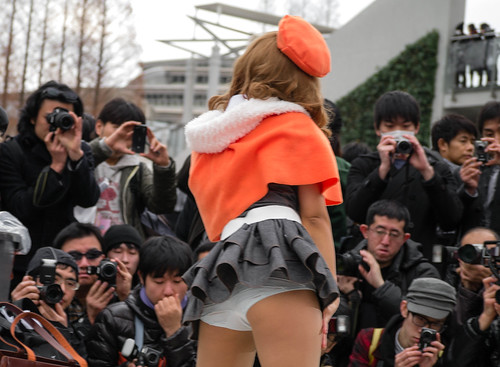
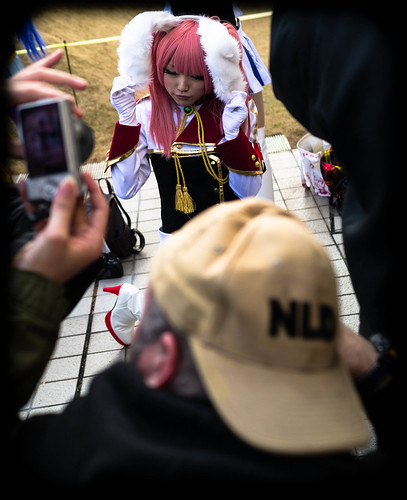
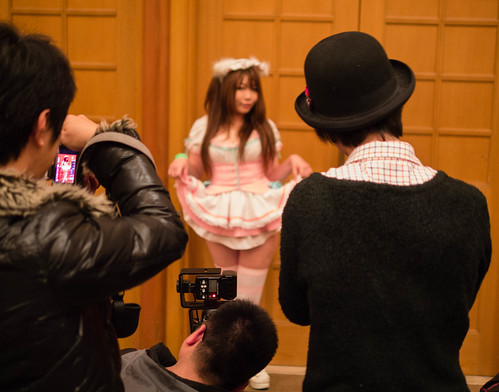
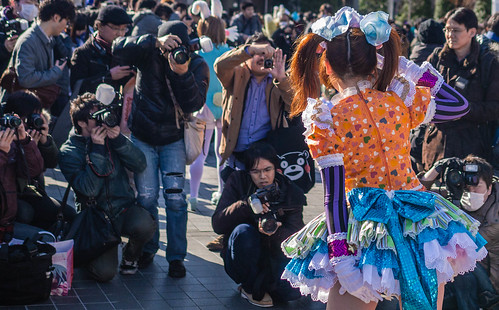
If you've ever been to an event with cosplay, then you're familiar with the fearsome tribe of otaku cameramen, the Camera Kozoh. Barking orders, demanding lewd poses, and pressing for contact information at the end of a grueling shoot, by all appearances they are unrelenting sadists that get off on dominating innocent models. But step into the personal space between the shooter and subject and you'll find that it's the exact opposite. The model has the cameraman wrapped around her little finger, and he would beg for the opportunity to grovel at her manicured feet.

Cosplay is an expensive hobby. The costume itself can easily run hundreds of dollars depending on how complicated the design and accessories are, not to mention hidden fees—upkeep and storage, makeup, trips to the salon, transport and entrance to events—the bills quickly add up for the model, who is likely either still in college or pinching pennies at an entry level position. For girls that plan to get serious about their hobby, first they need to find a way to monetize it—or at least avoid going too far into debt.

Enter the Camera Kozoh.

A good Camera Kozoh will round up a stable of girls that strike his fancy, then organize private photo shoots that serve as the model's main source of income. The photos serve as free advertising and materials for a future photo book. A pretty face might land a girl a few groupies, but to gain name recognition she'll need to tap into the gated community that the cameraman is member of.

Once he gets chummy with a cosplayer, maybe he'll act as her caddy, chauffeur, editor, web master, or even self-appointed manager—all pro bono, of course. To the Camera Kozoh who has already dropped thousands of dollars on monstrous camera rigs, footing the bill is a small price to pay for some facetime. His commitment holds the community together.
ComiketDay3 (6 of 20)
To the casual observer, this is where the arrangement falls apart. Aren't these cameramen just creepy middle-aged losers doling out cash for attention from young girls? To a certain degree, yes, probably. But economic constrictions keep any ulterior motives in check. Studio rental fees are prohibitively expensive and easily run half a grand for a session, so they need to buddy up to split the burden. Plus you need a crop of models to rotate between takes, with each asking for a hundred bucks or more to cover costs—a girl's 'gotta eat, after all.

This well-oiled system makes it easy to organize shoots, promote yourself, and make friends along the way for both the cosplayer and the Camera Kozoh.
Comiket83 (10 of 26)
It also places both parties in a prisoner's dilemma, except without reward for taking a risk. The cameraman wants to make a move on a model, but knows it would ostracize him from his peers and ruin his reputation for private shoots. The model wants attention and money, but if she gets too entangled with a single cameraman she risks alienating fans and the income they represent. “Bros before hoes” has never been a more fitting maxim.

The Camera Kozoh that seems oppressive at events is rendered mostly harmless from internal pressure and external economics. His weakness is obvious to everyone within the community—and most profitable to the ero-cosplayer.
Comiket 83 ero-cosplay and Camera Kozoh.
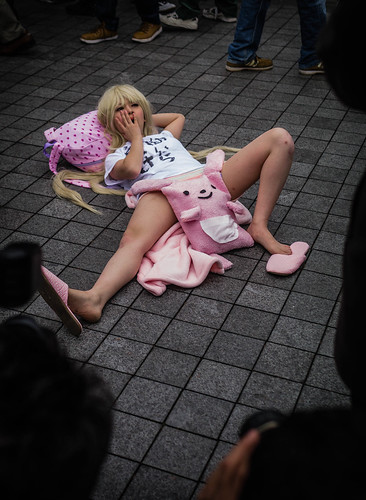
Her revealing costume seduce scores of willing men to purchase CDs filled with photos or videos of the model splayed out in compromising poses, legs open to men with open wallets. These salacious disks, or ROMs, are normally sectioned off from cosplay photo collections at Comiket, or even given adult-only events.

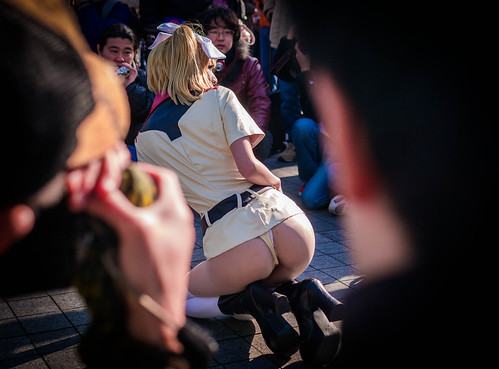
This doesn't stop these succubi from snaking into the photo pit to pass out business cards and promote their wares. If you see a semi-circle of telephoto lenses with flash bulbs strobing, chances are that behind the press of bodies a ROMer is working hard at a sales pitch.
Cosholic (1 of 2)
Cosholic, the premiere ROM-exclusive event, is conveniently held in the evening following the second day of Comiket. This allows the model to busk during the first two days, see her new fans at night, then follow-up with a meet-and-greet at her official booth on day three of Comiket.

Ever since the ROMers moved in during the early 90's, the Comiket Planning Committee has been wracking its collective brain-trust trying to find a way to host nudie cosplay without incurring the wrath of the law. Adult dojinshi are comics and as such exist in a legal gray-zone—erotic cosplay, on the other hand, falls squarely under Japan's pornography laws, particularly those outlawing the display of genitals.

Manga can get away with striking out a tiny strip of the offending region with a black bar or a heavy layer of mosaic chaff. If a ROM pulled the same stunt, it could be confiscated as indecent material under article 175 of the Penal Code, with Comiket held accountable as an accomplice.

A scrutinized event like Comiket wants to avoid giving more ammo to the media and more jurisdiction to the authorities at all costs. Hence they have introduced tighter standards of decency—tighter even than those for the off-the-shelf porno mags you find at the conbini. The planning committee may ban a ROM if it doesn't meet their criteria, but this plays right into the hands of the ero-cosplayer. The label “Too Hot For Comiket” is a masturbatory seal of approval and all the more incentive for a fan to visit Cosholic to pluck a bushel of forbidden fruit.
Cosholic (2 of 2)
Another major draw are photography tickets. Though the exact stipulations vary from girl to girl, buying a ROM gives the cameraman the right to interact one-on-one with the model and snap to his heart's content, or at least until her handler calls "time." While not as intimate as a studio shoot, it's also nowhere near the hassle—especially for pariahs that have burned all other bridges.

Though it's hard to argue against the predatory nature of models, blaming them for exploiting the cameramen is a knee-jerk reaction. Lonely guys seeking emotional fulfillment have any number of alternate money sinks.

The argument boils down to value—they must feel like they're getting their money's worth, or else would invest into soap lands instead. Likewise, the model needs to maintain a careful balance of professional distance and platonic romance to buffer the dream against reality. Cosplay is defined by role-playing where both parties are expected to perform their parts at all times. If you find this school of method acting too extreme, I suggest watching the drama unfold from the sidelines. Or through a the lens of a camera.
Comiket 83 cosplay of Harajuku street snap fashion.

Monday, July 2, 2012

History of Akihabara Part 3.5: 2.5D

Somewhere along the way otaku culture has gotten mixed in with mainstream culture. This interlude in our History of Akihabara series steps out of Electric Town to explore otaku elements pervading Japanese youth culture as well as the lifestyle alternatives they provide.


From Nemu's personal homepage.

Meet Yumemi Nemu, star of Denpa Gumi, the alternative idol unit for those who think that Momoiro Clover Z has gotten too mainstream. A Renaissance woman of sorts, when not behind the mic she moonlights as a DJ at the anisong club Mogra and models for gravure. I should also add that she doesn’t have a steady income, likely isn’t planning for the long term and may or may not be defaulting on her pension payments. But this isn’t intended as an attack on her free-wheeling ways. If anything, Nemu represents the growing number of young people searching for new lifestyles and values amidst the scrap of a broken employment system.

She’s a member of the so-called “Lost Generation,” a clumsy branding for those raised during the post-housing bubble double decade of economic deflation. These are the convenience clerk NEETs, the hikikkomori shut-ins, the drop-outs that felt their channels to mainstream society strangled by unforgiving educational elitism. Rather than put themselves back on the accepted path to success worn bare by their parents footsteps, they have continued on their outside vector towards unexplored venues of self-fulfillment.

Mainstream media is only now starting to acknowledge what youth of Japan have always known, deep down—that the old paradigm doesn’t work, that company life means no life at all, and that net culture can produce objects of real value.

Raised on low-fi fare like the Famicom without being spoiled by the high-rolling decadence of the bubble era, this generation isn’t afraid to spend the rest of their days working part time jobs so long as it means scraping up enough cash to pursue their hobbies and social activities. Some describe this worldview as 2.5D, which is exactly what it sounds like—the halfway point between 2D and 3D. It marks the intersection of fantasy space (anime, video games, the net) with real world space (art, gatherings, events).


Pink Sugar Heart Attack

For a visual example, look no further than the Neo Cosplay Collection.
Held at La Foret, Harajuku’s flagship clothing mall, the collection featured brands such as GALAXXXY who flip anime heroines into Punkey Brewster-style street wear. (Source)

If the crux of cosplay is to faithfully recreate the clothing of a character, then neo cosplay is concerned with adding to that look to make it your own. Imagine if an Akihabara maid went through the looking glass and emerged out of the closet of a Harajuku Fruits fashionista: The resulting spectacle would be enough to get anyone's pulse pounding.

Consider it the next step for pastel fairy kei fashion, augmented with otaku elements from Studio Pierrot’s magical girl shows like Creamy Mami. A natural fit, considering that the “sensational lovely” style pioneered by 6% Doki Doki drinks from the same carton of strawberry milk that fuels loli idol culture.

Shamelessly ripped from their homepage.

To paraphrase their homepage, the appeal of 6% Doki Doki comes from being blindsided by a flash of the extraordinary through the fog of the dreadfully ordinary. Entering the store you are transported to another world where Care Bears never stopped caring and purple becomes the natural compliment for pink. The shop girls are dressed like princesses from a parallel dimension. Brand maestro Masada Sebastian handpicks the heirs to his kawaii kingdom from a pool of over 200 applicants to preen into fashion models and performers for his avant garde stage shows.

Providing a reprieve from the everyday, producing young girls to serve as the brand image—6% Doki Doki shares its core concepts with amateur idol factories, the most productive being Akihabara’s Dear Stage.


Free Agents in the Game of Happiness

The interior of Dear Stage is intentionally lo-fi to create a home-made, school festival vibe. (Source)

Dear Stage is the mothership for the Moe Japan label captained by Tokyo University of the Arts graduate Fukushima Maiko. Her business model is 100% self-sufficient. Girls perform as idols on the first floor stage, play maid on the second floor cafe and flirt like hostesses in the low-lit upstairs bar—every male fantasy under one roof. And when a girl’s popularity hits critical mass, Fukushima is ready to produce and release their CD through her own record company, Meme Tokyo, a sub-label of Toy’s Factory.

While Fukushima’s girls aren’t going to steal the spotlight from AKB48 anytime soon, there are a handful of success stories amongst the hopefuls. And how does one even measure success? Each performer has their own personal dream to fulfill. Some want to top the charts, while others simply want a top-rated Nico Nico Douga account. They seem happy enough with whatever fame comes their way, so long as they can set the terms of said happiness.

The simple act of being active in a community you can call your own has become more important than the results of these actions. In her book, The Youth of Japan Are Not Unhappy (日本人の若者は不幸じゃない), Fukushima explains this phenomenon through the concept of “clusters.” Groups no longer need a centralized structure with designated leaders; rather, they can exist independently through a loose network of like-minded persons so long as there is a shared meeting place. These commons can be as expansive as Twitter or as pinpoint a venue as Dear Stage.

Clusters form around a concept or hobby. Take Hatsune Miku for example. Though technically owned by the developer, Crypton Future Media, all of the actual content, from artwork to music to choreography, is user generated. There’s no keystone holding the Miku architecture together. Famous artists may arise from the ranks, but they’re more of trend setters than visionary leaders.


Concentrated on the world wide web and spread across the globe, her legions of fans are simply waiting for their Field of Dreams moment: If you build it (or setup a concert), they will come. In droves, apparently. All 10,000 tickets to this year’s Miku Appreciation Festival sold out in a matter of hours. Most musicians would kill to have that devoted of a crowd, sans glowsticks.

The largest cluster of DIY youth culture is the self-published manga convention Comic Market, colloquially known as Comiket. Held bi-annually during the national summer and winter vacations, each incarnation draws over 500,000 visitors and 35,000 artist circles.

The convention hall has consistently been at full capacity for the past few years. (Source)

Comiket has a planning committee that screens applicants and ensures that everything runs smoothly, giving it the illusion of centralized management. In practice, their duties are more akin to crowd control than actual event planning. No, the true producers are the artists themselves. Their personal taste dictates what gets brought to the trade floor, each individual booth another link in the network. No single group can wholly represent Comiket, for this diversity is its defining characteristic.

Application fees are nominal and the event is free to the public. Ideally a circle would break even on the booth fee and printing costs. To some, a financial loss isn’t even an issue—having your work on display for others to see is worth the price of admission. Still others plan on turning a profit, with more popular artists able to pull in a living wage. The line between pro and amateur blurs. It’s hard to say which is more impressive: That mainstream manga artists supplement their income here, or that unsigned independents could possibly outsell them.

Like Dear Stage, Comiket provides alternatives—alternatives to white-collar work or blue-collar labor, and alternatives for socializing and personal expression. Sure, not every indie creator is going to make it big, but the
possibility is there. This possibility is just the release needed by youth who have fallen off the fast track or feel suffocated by society. Perhaps the Lost Generation isn’t drifting as aimlessly as everyone thinks. Perhaps they’ve been heading towards their appropriate clusters this whole time.

Once enough of these clusters amass, they form autonomous bodies with clear goals. In 2008, high school student Fujishiro Uso gathered disparate art communities from cyberspace and transported them into physical gallery space. Creators from Pixiv, Nico Nico Douga, 2channel and beyond leveraged social networks like Mixi and Twitter to magnify the manifesto of a new creative movement christened Chaos Lounge. Otaku culture was fed up with being marginalized by the mainstream, and the time hds come to hijack the architecture of the Internet to spread the message.

Art by Chaos Lounge's Umezawa Kazuki. (Source)

Their canvas would be the very room housing their installation pieces. Their palette was not limited to colors, but absorbed existing art and found objects in creating barely coherent pastiches, collages of characters familiar enough to be from any given anime, while generic enough to elude recognition. Much like the moe-ification of Akihabara, this terraforming process gave the nomadic Chaos Lounge tribe temporary bases—a place to belong.

Looking back, what changes did their post-modernist cultural revolution spark, if any? They transformed a hotel room into a free-form art commune, participated in an art battle royale, and created clothing for an Ura-Harajuku select shop, not to mention hosted nearly a dozen of gallery events. But aside from the praise provided by fellow otaku artist Murakami Takashi, Chaos Lounge has faced sharp disapproval, and from their supposed in-group at that.

Otaku, acting as the self-appointed governing body of the Internet, are hyper-judgmental of everything, especially their fellow brothers-in-arms. Vocal critics trash Chaos Lounge for being derivative, while fundamentalists expound that the institutions of art and otakuism should be kept separate. Murakami was flamed by his peers for these same reasons. Despite the glut of incriminating Dinner with Waifu photo dumps on 2channel and
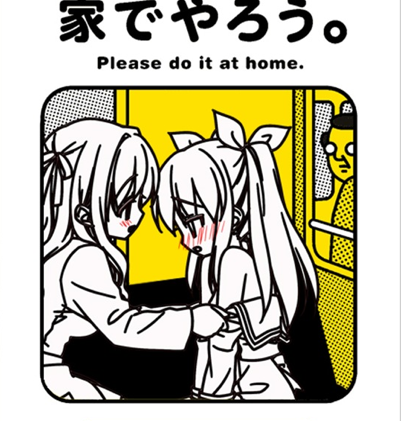
yatte mita “Check me out” videos on Nico Nico Douga, otaku expect each other to follow the same code of ethics as the rest of the country. Namely, you’re free to be a huge weirdo if you want. Just do it at home.

These demotivational posters in the station send mixed messages posted when next to the "No groping" adverts.

The Generation Gap and the Culture Gap

How can Chaos Lounge be fighting for otaku art but be hated by otaku? Why is Hatsune Miku considered to be fringe music despite scoring Oricon rankings and corporate sponsorship? If pornographic dojinshi moves more units than certain weekly serials, what’s keeping it off the Cool Japan menu?

There is a glaring breakdown of communication between the youth, otaku, and government. 2.5D helps put this into perspective by redefining the rules of engagement. Essentially, all parties are concerned with anime, manga, and the resulting media mix. They’re just operating within different spheres of interest.

Video games, light novels, online culture. For the current crop of digital natives raised on their parent’s comic collections, there is much less social resistance to these things than in the past. What many consider otaku culture is actually youth culture—and youth culture is mainstream culture.

Which isn’t to say that otaku culture, however you chose to define it, is dead. It still lives on, though there is a widening generation gap that starts somewhere between the mid 80’s and early 90’s. If you’re reading this blog, chances are you’re standing on the old man side of this divide with personal biases that don’t necessarily apply to those across the growing schism.

Ironically, as the classic image of the moe otaku gets pushed further into the background, more and more people are beginning to identify themselves as having a bit of an otaku streak. This doesn’t mean that they’ve broken down and bought body pillows, however. Online shopping and the media mystique of Akihabara have lowered the barriers of entry to fandom, making it easier than ever for anyone to pick up a high-grade sculpt of their favorite One Piece character or visit maid cafes unironically. Attitudes towards the label “otaku” have changed dramatically following Densha Otoko, elevating the hanging albatross into a self-depreciating badge of pride with a glint of sub-culture hipness.

One time Olympic athlete Narita Domu is proudly married to his snowboard and enjoys a more robust sex life than his average countryman.

This new breed of “light otaku” has been warmly accepted by business analysts and the tourist industry. A shrinking population means shrinking markets, unless you can find a way to convert new consumers to your product. Anime and manga manages precisely this with its comprehensive marketing blitz. Media mix casts a wide net of ancillary products guaranteed to snag a few fresh faces from the pool. Once you let yourself go with the flow, it’s only a matter of time before you find yourself purchasing some non-obtrusive character goods. After all, there’s not much difference between a moe blob and loosely-designed (though endearing) yuru-chara when they’re dangling from your cellphone.

With their mindless grins, local mascots make collecting useless baubles charming as opposed to a social faux pas. (Source)

Of course there’s more to being an otaku than mere consumerism. Following the success of Haruhi and Lucky Star, location hunting is back in a big way. Fans embark on seichi junrei, or pilgrimages to holy sites, to soak in the ambiance of the locales that inspired a title close to their heart. In the same way that Hatsune Miku concerts convert digital MP3s into a live listening experience, location hunting connects fictional settings with real world space. It’s the perfect motivator to get out from behind the computer screen and travel the country.

Between this, Tesujin-28 and marbled beef, Kobe has everything. (Source)

Accidentally showing up in an anime is the smartest PR move a city can make. Washinomiya shrine is the classic example—its visitors more than quadrupled after it appeared in the opening credits for Lucky Star. Capcom has organized a series of tie-ins featuring the locales and feudal battlegrounds from it's Basara series to make a pretty penny off reki-jyo, or female history buffs. The former Toyosato Elementary has since opened its doors (and vendor stalls) for K-On! groupies. Over the past few years Ueda City has organized summer festivals that coincide with the events of the Summer Wars movie. The otaku factor is free money for municipalities that are ready to capitalize on it.

The question, then, is what qualifies an otaku? The label means something different depending who you ask. The dictionary defines it as a person who is passionate and deeply knowledgeable in a specialized field. Culture critic Azuma Hiroki adds a post-modern twist by making them “database animals” in search of instant gratification. Gainax founder Okada Toshio holds them as a persecuted sub-sect who are the modern inheritors of Edo’s artisan culture. And psychologist Saito Tamaki deftly describes them as anyone able to get their jollies from nekkid cartoons.

On the one hand, this analysis comes off as an exercise in navel-gazing. And in a way it is, especially for those who consider being an otaku as part of their identity. But let’s not forget that anime and manga are serious business. A 2008 white paper produced by the focus group Media Create found that the combined sales of the otaku industry to be 186.8 billion yen (about 1.65 billion USD at the time), with nearly half of the sales from dojinshi.

The Economy Minister has his eyes set on Akihabara as a key to economic growth. Dentsu is primed to form an otaku think-tank to better market anime abroad. Cool Japan has evolved into Vibrant Japan, and if their sponsorship of AKB48 as the official face of the campaign is any indication, they’ve moved even further away from the pulse of what makes their country hip. They have otaku culture centered in their sights—except this makes them blind to youth culture, the lifeblood moving things forward.

If you’re interested in getting in on the ground floor to see Nemu-Chan and the other members of her unit in action, you don’t need to risk taking the plunge deep into Akihabara. Denpa Gumi is taking their act straight to Shibuya, the center of Japanese youth culture. And they’re not alone. Walpurgis Night, a Madoka Magica-themed DJ party, visited the city last June for an evening of anime song exuberance. Clusters like J-Geek are fighting to bring moe pop to the masses. To paraphrase an old otaku adage, "When there’s no room left in Akiba, the maids will walk Shibuya." With the appearance of the digital wonderland Maidreaming, it only seems like a matter of time before the prophecy is fulfilled.


Honestly, the whole scene, from denpa to dojinshi to experimental art, is not my thing. But without anything constructive to add to the ongoing movement, my opinion is practically irrelevant. Whatever these crazy kids are up to seems to be going well enough without curmudgeons like me mucking it up.

Given the alternatives
either staying holed up in your own personal bubble or doing the responsible thing by grinding your life away for just above minimum wagewhat they're doing is commendable, a faint beacon of hope for potential entrepreneurs that reaches beyond the otakusphere. The harsh realities facing Japan may not be so simple as to be flattened down to 2.5D, though this new perspective affords overlooked possibilities.

Notes and tidbits

2.5D

The entire concept of 2.5D discussed here was kick-started by its namesake company. 2.5D is a “Social television network,” meaning they regularly broadcast content over Ustream, a live feed service. Programming includes talk shows covering art, fashion, and music, as well as DJ events with a bent towards young creators and otaku culture. Shows are free over the internet, and for a modest fee, viewers can sit in on the recording at their studio located west of Shibuya.

Denpa-kei music

Denpa” literally means electronic signal or radio waves, like the one from your TV set. While the genre’s heavy use of synth and voice modulation seems to make “Electronica” a fair translation, Denpa refers to a more sinister type of signal--the invasive kind that makes the receiver go insane.

In 1981, a truck driver hopped up on amphetamines went on a stabbing spree in Tokyo’s Koto ward, killing four (including two children) and wounding two others. He claimed that signals sent directly to his brain commanded him to perform the murders. Although his plea fell through and he received life in prison without parole, his claim, along with recent scientific discoveries suggesting that electro-magnetism could effect the human body, popularized such schizophrenic and delusional stories as denpa experiences.

Denpa conveniently replaced the taboo term “kichigai” for describing the mentally unstable and quickly became the lingua franca for the subculture scene. Rock group Kinniku Shojyotai released hits like Denpa BOOGIE and Mr. Delusion about people being manipulated by outside forces.

In terms of modern music, it refers to songs made purposefully unlistenable, off-kilter, or even just plain weird that draws in fans simply for the sheer out-there factor. Better put on your tin-foil hat before clicking on the links above.


 Legality of Comiket

Despite the record-breaking success of Comiket, it and other dojin events have been skating on thin ice since their conception. Creating derivative works without explicit permission from the rights holder is clearly illegal, and as the handful of cases made by the publishers has established, indefensible in court. Dojin is only able to exist out of the benevolence of the original creator. So far, most authors have turned a blind eye to the issue for various reasons, thus allowing circles to thrive. This house of cards could soon collapse, however, depending on the direction things take in the current push by publishers for neighboring rights.

In brief, neighboring rights would allow publishers (and any entity involved in shaping or promoting the work) to effectively bypass the original author when making decisions regarding how the work should be represented. This includes launching an e-book version and, yes, pursuing legal action after pirates, including dojin artists. This has authors like Akamatsu Ken up in arms about what could be the first step towards wholesale seizure of creator’s rights by the publishers. More details here. And this is in addition to the looming specter of the TPP.


Lost Generation and The Zero Generation

As mentioned earlier, the Lost Generation are described as the youth left in the economic lull caused by the housing market collapse in the early 90’s. They’ve since adopted the mysterious moniker, Zero Generation (ゼロ年代). Led by cultural critics such as Hayamizu Kenro and Hiroki Azuma (see Genron), they are attempting to make sense of country affluent enough to be comfortable, yet with an income gap wide enough to cause disparity. How much is soul-searching worth in a wealth-driven consumer paradise? The Zero generation are aware that their gilded cage is beginning to peel and they are busy looking for a way out.

The 2008 White Paper on the Otaku Industry This report broke down the market into 5 categories: DVD/CD, published content, games (consumer products +PC), character goods, and dojinshi. I have been unable to find a similarly detailed document published any more recently, though Oricon rankings and others show that sales continue to grow, especially for light novels, mobile games, and dojinshi.


Denpa Otoko and the fall of Shibuya

In Denpa Otoko, a series of counterpoint essays, author Honda Toru trashes Densha Otoko for selling out and relinquishing his otaku habits for a set of Hermes tea cups and a warm bed. Honda refers to this exchange of physical goods for affection as “romance capitalism” and presents it as a conspiracy orchestrated by Dentsu and the mass media. The popular "pay to play" model is rotten to the core: Love for one’s 2-D waifu is the purest form of devotion, whether the sheeple realize it or not.

The cover is illustrated by Hanazawa Kengo of Boys on the Run and I am a Hero fame. All of his manga feature thirty-year underdogs, none so more prominently than his 2004 debut about unrequited virtual reality love, Ressentiment. In the not-too-distant-future, the young couples of Shibuya are replaced by otaku bachelors as Akihabara spreads its influence across the archipelago.

Shibuya's fate is then sealed with the 2008 visual novel CHAOS;HEAD. The clinically delusional cast flatten the city with a dementia-fueled earthquake brought about by the locales unique "gravitation error rate," which is pseudo-science for denpa.